Independent school · Highgate, London
Highgate School
11+ entry in September 2027: the current assessments, sample papers, fees and practical preparation.
Bursary and Music Award applications also need action by this deadline.
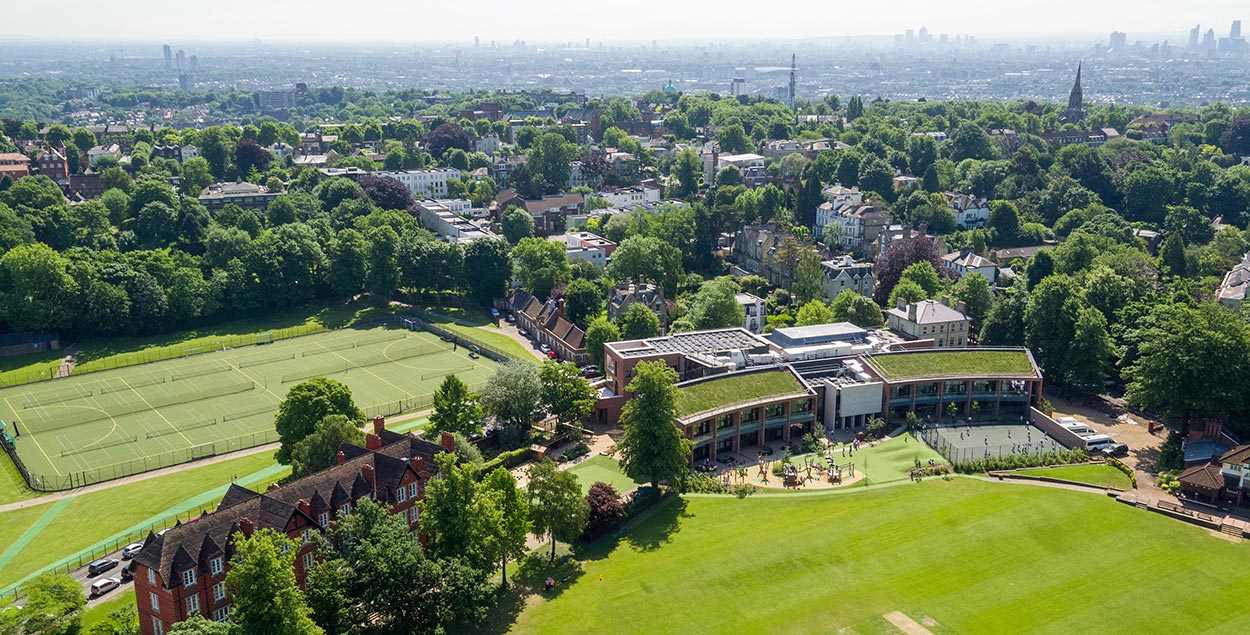
Highgate is a coeducational day school in north London. About 80 children join Year 7 from other schools, alongside around 105 moving up from Highgate Junior School.
For September 2027 entry, candidates take written English and maths, followed by a group interview and taster lessons for selected children. The maths sample uses controlled page turns, while English gives equal marks to reading and writing.
At a glance
- School
- Independent · coeducational · day
- Year 7 intake
- About 80 external placesAlongside around 105 Junior School transfers
- Apply by
- 4 November 2026 · noon
- Written tests
- English and mathematicsGroup interview and taster lessons follow for selected candidates
- 2026–27 tuition
- £10,929 per term incl. VATCompulsory lunch costs another £369 per term
- Financial support
- Means-tested bursariesMusic Awards also available
Inspection report
- Inspectorate
- Independent Schools Inspectorate
- Inspection
- 24–26 September 2024
- Outcome
- All required standards met
Inspectors identified teaching as a significant strength: knowledgeable teachers encourage intellectual effort and independent learning. The report also describes tailored support for pupils with SEND and English as an additional language.
The recommended next step was to maintain the physical environment of common inside areas and classrooms across the Senior School to a good standard. This is a useful point to follow up on a visit.
Admissions contacts & visiting
- 11+ Admissions Officer · Joe Dyda
- senioradmissions@highgateschool.org.uk020 8347 3564
- School reception
- 020 8340 1524office@highgateschool.org.uk
School address
North Road, London N6 4AY- Getting there
- Highgate Underground station (Northern line, High Barnet branch) is an 8–10 minute walk. Buses 143, 214, 263 and 603 stop outside the Senior School; 210 and 310 stop nearby at South Grove. The school also offers a paid coach service; check the current route and place availability.
- Parking
- For a Senior School appointment, a parking space inside the North Road gates can sometimes be reserved on request. Arrange this before travelling. Bishopswood Road has a School Street during term-time drop-off and pick-up; it is a different site.
The Admissions Office opens Monday to Friday, 9am–5pm. Open events for 2027 entry have concluded. The school expects to announce its autumn 2027 event for 2028 entry in spring 2027; register interest to receive the booking details.
Who can apply?
September 2027 entry is for children born between 1 September 2015 and 31 August 2016. Candidates must be in the equivalent of Year 6 when tested. Apply directly to Highgate using its online application.
For children outside the usual age group, the policy expects the arrangement to have existed since Reception or to reflect compelling medical or pastoral reasons; evidence may be requested before an application is accepted.
Who can apply?
| Issue | What families need to know |
|---|---|
| Learning needs and adjustments | Disclose learning difficulties, disabilities and relevant medical or pastoral circumstances when applying. Supply a medical or educational psychologist’s report or other relevant evidence early. Possible adjustments include large print, extra time or a laptop, assessed individually. |
| English as an additional language | Children need enough English to access the curriculum; the policy allows appropriate allowances. Ask admissions for guidance before testing. |
| Siblings | A sibling is not guaranteed admission or an interview. Each child is assessed individually; sibling status or a particular talent may be a preference between candidates who meet the criteria. |
| Location | The general 11+ policy does not publish a fixed catchment. Bursaries focus on the local community; check the daily journey and any support eligibility. |
Key dates for 2027 entry
All dates and times are UK time.
- View details
Application, bursary form and Music Award deadline
Submit the main application on time. Bursary applicants must also return the financial assessment form by the application deadline.
- View details
Written English and maths tests
Official provisional date. Follow the time and arrival instructions in your invitation.
- View details
Activities and interviews begin
Invitation only. Official provisional window; attend on your allocated day.
- View details
Offer letters sent
Official provisional date.
- View details
Acceptance deadline
Official provisional date. Follow the exact acceptance and deposit instructions in the offer letter.
Highgate marks all dates in its 2027 key-dates calendar as provisional. Check your individual invitation before booking travel.
Additional joining events
| Stage | School’s published timetable |
|---|---|
| Offer-holder event | Late February 2027. |
| Welcome events | Family event in June; team-building activity day in August. |
Music Award dates
The official Music Award booklet confirms a Musical Discovery Day on 7 January 2027 and second-round auditions on 14 or 15 January 2027. Its summary page contains a 2026 year typo for those auditions; the detailed audition page says 2027.
How to apply
Apply by noon on 4 November
Complete the online form and pay the £210 application fee, or arrange a bursary-related reduction. Indicate bursary or Music Award interest and disclose any access needs.
Complete additional forms
Bursary applicants receive a financial assessment form, due by the application deadline, with supporting documents due in early December. Music applicants receive a separate online award form.
Take the written tests on 1 December
Attend Highgate for English and mathematics on the provisional test date, 1 December 2026. The school also requests a confidential reference from the current headteacher.
Return on 11–15 January if invited
Selected candidates attend a group interview and taster lessons on an allocated day in the provisional 11–15 January 2027 window. The school interviews more children than it has places.
Offers on 12 February; accept by 3 March
Final decisions predominantly follow written-test ranking, with interview performance and school references also considered. The provisional offer and acceptance dates are 12 February and 3 March 2027. Accept in writing and pay the £4,000 deposit according to your offer letter.
The entrance assessments
English
1 December 2026 · provisional
School-set written paper
- Subjects
- Comprehension, analysis and creative writing
- Time
- 45 minutes
Current samples allocate 30 minutes to reading and Questions 1–3, then 15 minutes to writing and checking.
English sample 1Mathematics
1 December 2026 · provisional
Written, with controlled page turns
- Subjects
- Four multi-part problems: arithmetic, fractions, percentages, ratio, geometry and reasoning
- Time
- Approximately 45 minutes
Show working. Move to another part if stuck, but wait for the instruction to turn to the next question; the cover says you cannot return to an earlier question.
Current maths sample AGroup interview and taster lessons
11–15 January 2027 · provisional · invitation only
Activities with other children
- Subjects
- Listening, collaboration, problem solving, curiosity and teachability
The policy says this is not a second academic test. Written-test ranking remains the predominant factor in final decisions.
Selection policyThe 2027 policy specifies English and mathematics and records the removal of the non-verbal reasoning paper. English reflects the Key Stage 2 curriculum. For maths, Highgate says no specific syllabus or special preparation is necessary; the sample is the clearest guide to the style of reasoning required.
Highgate papers
Start with the current school-linked Maths Sample A and the three English practice papers. Library Maths A contains the same questions as the current official A. Papers B and C provide additional practice in the same controlled-page format; the file labelled D in the library is an untimed six-question example handout.
English practice papers 1–3
45 minutes each30 minutes comprehension and analysis; 15 minutes creative writing and checking. Each has 30 marks, including 5 for spelling, punctuation and grammar.
Current Mathematics A
Approximately 45 minutesFour main questions with 19 subparts. Page turns are controlled. The linked school answer file uses earlier wording for some parts; see the marking note below.
All papers on Elevenfold
View the collection11+ Mathematics Sample Paper A
Approximately 45 minutes
Undated 11+ sample; the same question set as the current school-linked Mathematics A. Four main questions, 19 subparts; controlled page turns. The school-linked worked answers use older wording for Q1(d) and Q2(d); check the marking-version note before using them.
11+ Mathematics Sample Paper B
Approximately 45 minutes
Undated 11+ sample in the controlled-page format. Four main questions, 18 subparts; additional library practice.
11+ Mathematics Sample Paper C
Approximately 45 minutes
Undated 11+ sample in the controlled-page format. Four main questions, 19 subparts; additional library practice.
11+ Mathematics Example Questions
Six-question 11+ example handout. The cover says “Example Questions”, not “Paper D”; no printed time limit or examination year.
Marking Maths A: two answers depend on the version
The school links an older worked-answer file alongside the current paper. In current Q1(d), Donald buys 54 slices but the question asks how many more than Alisha’s 3, so the answer is 51. The older file asks how many he bought and gives 54.
Current Q2(d) requires three fertilizer sacks per 4 m², so 60 m² needs 45 sacks. With every fifth sack free, 36 are paid for: £360. The older answer file uses one sack per 4 m² and gives £120. Q1(e) doubles both the number of chops and total cost in the current paper, leaving the unit prices unchanged.
Use the timing printed on the PDF: A, B and C say approximately 45 minutes. The example-question handout has no printed time limit. These undated sample labels are not examination years.
English: evidence, word choices & description
The reading allocation is 30 minutes, including time to read the passage. Start with the task structure below: short retrieval answers, then explanations of language, followed by a focused piece of writing.
English: evidence, word choices & description
| Published task | What a complete response does | A common gap to correct |
|---|---|---|
| Q1 · vocabulary and retrieval · 3 marks | Choose the word from the specified paragraph; give two separate details for the retrieval part. | A suitable synonym from elsewhere does not answer a request for a word in one paragraph. Two versions of the same detail are still one point. |
| Q2 · quotation and explanation · 4 marks | Copy a short relevant quotation, then explain the meaning or associations of its words and connect them to the stated impression. | A quotation alone is only the first part. “It is a metaphor” names a device but does not explain what it makes the reader imagine. |
| Q3 · two impressions, then analysis · 8 marks | Give two distinct impressions. Develop one of them using two quotations, explaining how each supports that impression. | “Frightening” and “scary” repeat one idea. In part (b), explain both quotations rather than repeating the impression after each. |
| Q4 · description or diary · 15 marks | Answer every part of the writing brief. Develop a focused place, change or encounter, then check sentences, spelling and punctuation. | An elaborate plot can crowd out the requested description. In paper 2 the change must be from busy/noisy to quiet/peaceful; paper 3 also requires a person. |
See how to develop a reading answer
Teaching example · two impressions and a developed explanation
Read this original practice passage: “Mara’s heel tapped the platform while she watched the clock. She folded her ticket into a tiny square. When the unfamiliar train arrived, she straightened her shoulders and stepped towards the open door.” Give two impressions of Mara. Choose one and explain it using two short quotations.
See the approach
Mara seems anxious but also determined. Her heel “tapped the platform”, suggesting restless movement while she waits. Folding her ticket into “a tiny square” suggests nervous fiddling rather than calmly keeping it ready. These details support the impression of anxiety.
“She is anxious because she taps her foot” identifies an idea but develops only one detail. The fuller answer explains two pieces of evidence. “Determined” is supported separately by her straightened shoulders and decision to board. Other interpretations are possible if the words support them. This passage and model are Elevenfold teaching material, not a Highgate question or official mark scheme.
Explaining an effect · Practice Paper 1, paragraph 6
How can the phrase “Darkness poured out” shape the reader’s impression?
See the approach
It makes darkness seem like a liquid spreading through the jungle and filling the spaces between trees.
This links the verb to a clear picture and an effect. A child could develop the point using a second quotation from the paragraph, as Q3 requires. This is a teaching example, not an official mark scheme.
English: evidence, word choices & description
| Official paper | Reading focus | Writing brief |
|---|---|---|
| Practice 1 · Simon in the jungle | Changes in light, flowers and atmosphere; how description creates a sense of enchantment. | Describe finding yourself in a new place in a city: where it is, what it is like and how you feel. |
| Practice 2 · the Mulberry Garden | How a garden becomes frightening, then how the children’s movement and appearance are presented. | Describe a busy, noisy place becoming quiet and peaceful; show how the place and your feelings change. |
| Practice 3 · a Greek island villa and Spiro | Unusual flower imagery, then impressions of Spiro through his actions, speech and others’ reactions. | Write a short holiday diary entry describing a strange destination, a person encountered and feelings about them. |
Practise the 15-minute writing task
A useful home-practice split is 2 minutes to plan, 10 to write and 3 to check. Highgate specifies 15 minutes including checking; the 2/10/3 split below is a suggested practice routine, not a school rule.
Practise the 15-minute writing task
| Practice stage | What to do | Check before moving on |
|---|---|---|
| Plan · 2 minutes | Underline the brief’s requirements. Choose a place and a feeling; for paper 2 decide what changes, and for paper 3 choose the person encountered. | Can your child say what the reader should picture at the start and at the end? |
| Write · 10 minutes | Develop a few details through sight, sound, movement or reaction. Keep the narrator and tense consistent. | Does each paragraph add something to the requested place, change or person? |
| Check · 3 minutes | Re-read the brief, then the answer. Fix missing requirements, unfinished sentences, tense slips, capitals and punctuation. | Can a reader follow the sentences without supplying missing words or guessing where one sentence ends? |
Teaching example · showing a change in atmosphere
A pupil writes: “The market was busy and noisy. Then everyone left. It was quiet and I felt relaxed.” Improve the description so the reader can hear the change and recognise the feeling through the narrator’s actions.
See the approach
I squeezed between elbows and baskets as traders called over one another. A shutter rattled down; the last voices drifted away. Beside the fountain, my footsteps sounded unexpectedly loud. I let out a breath and slowed down.
The first sentence establishes crowding and noise. “Rattled”, “drifted away” and the newly audible footsteps make the change specific; the released breath and slower pace suggest relief. The improvement comes from selecting details, not adding several adjectives to every noun. This is an original teaching example for the kind of change requested in practice paper 2, not a school model answer.
After an attempt, choose one improvement only: clearer setting, a more convincing change, a more revealing description of the person, or stronger sentence control. Rewrite a short passage, then try a different prompt later. Avoid memorising the model description.
Vocabulary from the English samples
Use the words in their original passages before revealing a meaning. Ask for a meaning in context, then a new sentence. The samples directly test canopy, surrendered and laboriously; the other words help with understanding and explaining the passages.
Mathematics: priorities, methods & worked examples
Maths A has four main questions and 19 subparts. A familiar setting can lead from a straightforward calculation to a problem with a changed whole, an unknown price or several linked conditions. Start with an untimed question and identify the first step your child cannot explain.
Choose the next teaching priority
| What the attempt shows | Teach next | Check the method |
|---|---|---|
| Calculations are accurate, but fraction or percentage answers are wrong. | Identify the whole at each stage; use a bar or percentage scale before calculating. | Can your child say what “one quarter of what remains” or “150% of the original” refers to? |
| One-step work is secure, but the later parts cause difficulty. | Break a problem into linked quantities: equal ratio parts, two matching purchases or a fixed total. | Can your child label each intermediate result and explain why it is useful? |
| A plausible calculation produces an impossible practical answer. | Interpret remainders, units and what the question actually asks. | Does the answer buy enough containers, stay within the budget, use square units or name the correct group? |
| Answers appear by trial, without a reason. | Organise cases or test a claimed rule against the conditions. | Can your child explain why the result must work, including a worst-case selection or an impossible total? |
Worked examples: changing wholes, ratio and complete packs
Try each question before opening its method. These original exercises teach relationships used in the Highgate samples; they are not predicted examination questions.
Teaching example · a fraction of the remainder
A stall sells three fifths of its bookmarks on Saturday. On Sunday it sells one quarter of the remaining bookmarks: 8 bookmarks. How many were there before Saturday’s sale?
See the approach
80 bookmarks.
Sunday’s 8 bookmarks are one quarter of the remainder, so 8 × 4 = 32 remained after Saturday. That remainder is two fifths of the original stock. One fifth is 32 ÷ 2 = 16, so five fifths are 80. Check forwards: 48 sell on Saturday; 32 remain; one quarter of 32 is 8. Taking 8 × 4 = 32 as the original stock stops one stage too early. This is an original teaching example, not a past-paper question.
Teaching example · a fraction followed by a ratio
Each club member plays exactly one of chess, hockey and tennis. Three eighths play chess. The remaining members play hockey or tennis in the ratio 2:3. There are 27 tennis players. How many members are in the club?
See the approach
72 members.
The 27 tennis players represent three ratio parts, so one part is 9. Hockey and tennis together have five parts: 45 members. Those 45 are the five eighths left after the chess players. One eighth is 9, so the whole club has 72. Check: 27 play chess, 18 hockey and 27 tennis; these sum to 72. The ratio divides the remainder, not the whole club. This is an original teaching example, not a past-paper question.
Teaching example · round up for capacity, down for a budget
A nursery must pack 158 plants. Each crate holds at most 12 plants and costs £18. The budget is £250. How many crates are needed, how many can be bought, and is the budget enough?
See the approach
14 crates are needed. The budget buys 13 crates, so it is £2 short.
13 crates hold 156 plants, leaving 2 unpacked: a fourteenth crate is necessary. Thirteen crates cost £234, while fourteen cost £252. A spare £16 cannot buy another complete crate. The capacity calculation rounds up; the budget calculation rounds down. This is an original teaching example, not a past-paper question.
Money, unit prices and multi-step calculation
Separate the cost of each group, keep pounds and pence consistent, and reverse change to recover what was spent. For packet questions, decide whether a remainder means rounding up or buying fewer complete packs.
Check the method: Can your child explain why the number of tanks in B1(b) must round up, while the number of potato sacks in C1(b) must round down?
A1(a–c), B1(a–c), C1(a–d) and the example handout Q1.
Fractions of what remains
Draw a bar for the original whole and a second stage for the remainder. When working backwards, undo the final fraction first. In B2(d), the shaded amount stays fixed but the whole becomes smaller.
Check the method: What quantity does each fraction refer to: the original total, the remainder or the new whole?
A1(d), B2(a,c,d), C1(e); example Q4.
Percentages and recovering the original price
Find the complement when asked for adults rather than children. For reverse percentages, identify what percentage the new price represents: after a 50% increase it is 150% of the original, while after a 40% reduction it is 60%.
Check the method: Can your child explain why subtracting 50% from the new price does not undo a 50% increase?
A2(b), A4(a–c), B3(a–c), C4(a–c); example Q2.
Ratio, proportion and mixed quantities
Use equal parts to divide a total. Keep track of the ingredient requested when a mixture gives the other ingredient’s amount. Combine the fractional share with the ratio for the remaining groups.
Check the method: Has the answer used the entire total, and does it answer for sand or gravel, hot or cold water, the correct team or the correct colour?
A3(a–c), A4(e), B3(e), C3(a–b), C4(e).
Area, dimensions and units
Read labelled lengths rather than measuring the drawing. Split the lawn into rectangles or subtract unwanted regions. Convert paving dimensions into the same unit as the patio before dividing areas; check the tiles fit.
Check the method: Can your child distinguish a side length in metres from an area in square metres?
A2(a,c): 23 m by 9 m garden, 2 m borders and 8 m by 3 m patio; B4(b) identical rectangles; example Q5 area and perimeter.
Common factors and sequences
Use the shared whole-number side to connect two rectangle areas. For matchsticks, identify how much each new shape adds and account for the starting shape. Test whether a proposed total belongs to the sequence.
Check the method: Can your child explain why a number is impossible, instead of only extending a short list?
A3(d) shared-side rectangles; C2(a–d) matchstick rules and largest class size; example Q3 repeating food schedule.
Unknown prices, paired totals and overlapping sets
Compare purchases with matching quantities, or double one purchase to eliminate an item. Add paired animal weights carefully: each animal is counted twice. For the language question, separate pupils studying both languages from pupils studying only one.
Check the method: Does the answer satisfy every original condition, not just one equation?
A1(e), A3(e), A4(d), B3(d), C3(c), C4(d), C2(e).
Explain a guarantee or a winning strategy
For B4(a), imagine the worst possible selection before deciding what is guaranteed. For the example handout’s card game, track which cards remain, an opponent’s immediate threat and the next move. For B4(c–d), pair terms of an arithmetic sum and account for both outward and return runs.
Check the method: Can your child show why the conclusion must hold, rather than giving one lucky example?
B4(a,c,d), C3(d) multiplication triangles, and example handout Q6.
Rehearse the controlled page turns
The maths cover says to move on from a difficult part, but not to turn the page until instructed. Use spare time to check the current page: returning to that question later is not allowed. This requires a different habit from saving every difficult question for the end.
Read the target before calculating
Underline the quantity requested and keep working beside the relevant part. A correct total is not an answer to a question asking for a difference.
Move within the permitted page
If one part stalls, attempt the next part on that page. If it uses an earlier result, show the method you would apply; do not assume every later part is inaccessible.
Check before the page is closed
Use spare time to check units, the named person or group, arithmetic and whether the answer fits the conditions. Read the instruction again before turning.
Practise this first without time pressure, with an adult controlling page turns. The cover gives approximately 45 minutes for the complete paper but no fixed time per page; use the examination invitation and invigilator’s instructions for the actual sitting.
Plan the next teaching session
Choose the next session from an attempted question, not from a longer list of papers. Correct one underlying difficulty, then check it on a fresh task.
Plan the next teaching session
| What you notice | A focused task | Evidence that the teaching helped |
|---|---|---|
| English answers name a feeling or device but stop there. | Use one short quotation. Explain its key word, then connect the meaning to the impression. Add a second piece of evidence only when the first explanation is clear. | The child explains how each quotation supports an interpretation without copying a sentence frame mechanically. |
| Writing is accurate but thin, or detailed but unfinished. | Take one published brief. Plan its required details, write a focused description and leave a checking window within 15 minutes. | The answer completes the brief, develops selected details and remains readable sentence by sentence. |
| Maths breaks down when a second condition appears. | Choose one worked example above, cover the method and label the whole, ratio parts or practical limit before calculating. | The child explains what each intermediate result represents and solves a fresh question without the same prompt. |
| Correct maths is lost through page management. | Rehearse one controlled page turn. Check answers on the current page before the adult signals to move. | The child checks units and the requested quantity now, rather than planning to return at the end. |
Attempt, then locate the first difficulty
Use one unseen subquestion or one short reading response without help. Ask the child to explain the first step. Distinguish a missing skill from misunderstood wording or an arithmetic slip.
Teach one method and try it independently
Work through the relevant example together, then close it. Use a different question on the same skill. If a prompt is still needed, stay with that skill rather than moving to a harder paper.
Return to realistic exam practice
When methods are secure, use a fresh complete English sample with its 30/15-minute split. Use the printed controlled-page instructions for maths. Keep the second copy of Maths A for review, since it is not an unseen test.
Check retention on another day
Ask for an explanation of a previously difficult method or word without showing the answer. Keep the next practice list short and specific.
Group interview & taster lessons
Activities and interviews are provisionally scheduled for 11–15 January 2027. The 2027 policy says the group interview is not a second academic test. A team of staff observes listening, collaboration and problem solving, alongside curiosity, teachability, behaviour and interest in school life.
The written-test ranking remains the predominant factor in final decisions; the group interview and current-school reference also contribute. Preparation should help a child think with other people and respond to a new idea, rather than rehearse an individual academic interview.
A short collaboration exercise to try at home
A short collaboration exercise to try at home
| What to notice | A useful follow-up | What progress looks like |
|---|---|---|
| Listening | What did the other person suggest, and which part could you use? | The child can summarise the suggestion accurately before adding or changing it. |
| Reasoning | How would your plan include all six pupils within the time? | The child connects an idea to the actual constraints instead of simply insisting on a favourite activity. |
| Adapting | What changes now that the ball is unavailable? | The child revises a plan, asks a question or accepts a useful alternative without treating the change as failure. |
| Participation | Whose idea have we not considered yet? | The child contributes and makes room for another voice. Being the loudest or the designated leader is not the aim. |
Discuss one thing that helped the group and one thing to try differently. These observations are a home-practice guide, not Highgate’s scoring rubric. Normal shared projects, games and conversations can develop the same habits.
For conversation about interests, choose a real book, activity or question your child enjoys. Ask what specifically caught their attention and what they would like to explore next. A taster lesson is also a chance to listen, ask when an instruction is unclear and try something unfamiliar.
Fees & deposits
- 2026–27 tuition
- £10,929 per term incl. VAT£32,787 for three terms
- Compulsory lunch
- £369 per term · no VAT£1,107 annually
- Tuition plus lunch
- £11,298 per term£33,894 annually at 2026–27 rates
- Application
- £210 incl. VATPayable with the online application
- Acceptance deposit
- £4,000Retained until the pupil leaves
Fees & deposits
| Cost | Published arrangement |
|---|---|
| Overseas testing | £420 including VAT for entrance tests taken abroad by prior agreement with Admissions. Ask which charge applies to your arrangements. |
| Included | Books, stationery, compulsory fieldwork and curricular day visits. |
| Extra charges | Public-examination entry and administration are billed separately and are not subject to VAT. |
| Individual music tuition | £45.24 for 35 minutes or £64.68 for 50 minutes, including VAT. Instrument hire is priced separately. |
These are the published 2026–27 rates. A child starting in September 2027 will need the 2027–28 fee schedule when it is issued.
Help with fees
Means-tested bursaries can cover up to 100% of fees. Indicate bursary interest on the main application, then return the financial assessment form by 4 November 2026 and supporting documents by early December. Financial information is kept confidential and does not affect the academic assessment.
Help with fees
| Family circumstances | Published guidance, subject to assessment |
|---|---|
| Income below £45,000 | Without significant assets, a child could qualify for full fees and help with uniform, IT or educational trips. The application fee is reduced from £210 to £30; contact admissions if even that is unaffordable. |
| Income £45,000–£107,000 | A partial bursary may be available. |
| Keyworker families | One full-fee equivalent bursary is allocated each year for a local keyworker family. Enhanced support may be considered up to £125,000 total family income. |
| Assets and circumstances | Income thresholds are guides. Assessment also considers outgoings, assets, liabilities, the family home and family size. |
Candidates invited to the January second stage have an online financial meeting with Bursary Assessment Associates. Highgate decides the award using that assessment, demand and available funding. Preference goes to children at state schools; an award to a child already at an independent school requires unusual circumstances.
Keyworker definition and outcome timing
The school defines keyworkers as public-sector employees in frontline essential services. Examples include clinical NHS staff other than doctors and dentists, teachers, police, prison and probation staff, firefighters, ambulance crew and armed forces. The programme is aimed at families with two keyworker parents, while circumstances with one qualifying parent are considered.
The bursary page says families will hear by the end of January; general admissions gives early February. Follow the individual written outcome and contact admissions before relying on either date.
Music Awards
Highgate offers Music Scholarships, Exhibitions and Music Potential Awards at 11+. It does not offer academic scholarships. Music applicants must gain a place through the normal admissions process and indicate their interest on the main application to receive the separate music form.
Music Awards
| Award route | Indicative standard |
|---|---|
| Scholarship or Exhibition | Two instruments or voice: Grade 5–8 standard on the first and Grade 3+ on the second. |
| Music Potential Award | Exceptional potential on voice or one ensemble instrument other than piano, at Grade 3–5 standard. |
Formal grade examination certificates are not required. Invited candidates attend the Musical Discovery Day; selected musicians return for an approximately 20-minute audition, including around 10 minutes of prepared music, sight-reading, aural work and conversation. Scales are not requested.
The dedicated 2027 booklet describes scholarship fee remission up to 10%, potentially combined with a bursary, plus free instrumental tuition. The admissions policy allows occasional scholarships up to 20%; ask the Music Office to confirm the applicable award. Exhibitions and Potential Awards provide tuition without fee remission.
Examination results
- 2026 GCSE entries
- 96.2% at grades 7–9
- 2026 GCSE entries
- 86.6% at grades 8–9
- 2026 GCSE entries
- 61.7% at grade 9
- 2026 A level grades
- 87% A*–A52% A*; 98% A*–B
These percentages describe examination entries or grades, not the share of pupils achieving a complete set of those grades. The school separately reports that 95% of the 2026 leaving cohort received their first or insurance university choice, and 34 pupils gained Oxford or Cambridge places.
Year 7: subjects, friendships & support
Starting Senior School
| Part of Year 7 | What the school provides |
|---|---|
| Subjects and languages | French and Latin are taught to everyone in Year 7. General science introduces scientific methods and investigations; separate biology, chemistry and physics begin in Year 8. Art, drama and music have weekly lessons. |
| Forms and friendships | Years 7 and 8 each have eight forms of no more than 24 pupils. Forms mix new entrants with Junior School pupils, and children spend almost all lessons with their form. |
| Joining the school | The usual induction includes an activity afternoon and site tour, a parent information evening and a family barbecue. An outward-bound visit just before September gives the new year group time together before lessons begin. Follow the joining programme for the specific year. |
| Who to contact | The form tutor supports the pupil; the Head of Year is the usual day-to-day contact for parents in Years 7 and 8. Additional support includes learning support, counsellors, wellbeing practitioners, school nurses and a clinical mental-health lead. |
| Clubs during the school day | Thursday lunchtime activities are compulsory in Years 7–8; Friday activities are optional for these years. Current Thursday examples include sign language, VEX robotics, Puzzle Club and squash. The wider Senior School has over 100 activities, clubs and societies. |
| Residential visits | The current curriculum programme includes a three-day Year 7 trip to Lille in the fees. Additional sports tours and other trips have separate arrangements; check the joining information before budgeting or making plans. |
Before accepting, ask for the current Year 7 timetable, homework expectations and arrangements for any additional modern-language choice. Check how your child’s preferred activities fit the journey home, especially after a late finish.
Other entry points
Highgate has separate entry processes at 4+, 7+ and 16+. Occasional Senior School places may become available before Year 10 when a pupil leaves and the year group has capacity. These do not form a guaranteed alternative 13+ intake.
The 11+ policy says a new application after an unsuccessful attempt is highly unlikely to be accepted less than two years after the original intended entry point. Contact admissions about eligibility before planning another assessment.
Other London schools to compare
Boys’ day school in central London. Compare current entry tests and the journey from north London.
Girls’ day school at the Barbican. Compare its admissions route, fees and commute.
Dates relate to September 2027 entry. Fees are the published 2026–27 rates; use the school’s invitation and offer letter for individual arrangements.