Independent school · Manchester
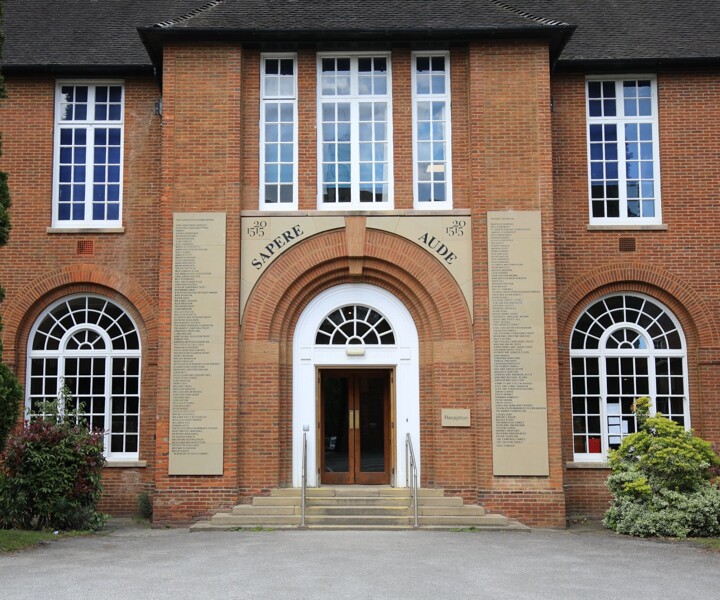
The Manchester Grammar School
Year 7 entry for September 2027: the taught Assessment Day, English and arithmetic papers, fees and practical preparation.
For September 2027 entry
The Manchester Grammar School is a selective boys’ day school with a regional intake. Its Year 7 process combines a small-group day of new lessons and activities with a separate January examination. Both matter: the school considers how a boy learns as well as what he can already do.
At a glance
- School
- Independent boys’ day school
- Year 7 route
- Assessment Day + entrance examination
- Apply by
- 18 November 2026 for guaranteed assessment
- Written examinations
- 13 January 2027
- Tuition
- £6,603 per term incl. VAT · 2026–27
- Financial support
- Means-tested bursaries at 11+ and 16+
Contacts, visits & travel
- Admissions Manager · Kath Heathcote
- k.t.heathcote@mgs.org
- Admissions office
- admissions@mgs.org
- Admissions telephone
- 0161 224 7201 · ext. 234 or 249
- Transport enquiries
- transport@mgs.org
School address
Old Hall Lane, Manchester M13 0XT- Getting there
- MGS is a regional day school. School shuttles connect with Manchester Piccadilly and Victoria; other routes include Altrincham, Cheadle/Bramhall and Worsley. Private services cover further areas. Check the current timetable and the journey home after activities before applying.
- Parking
- For driving, the school specifies sat-nav postcode M14 6HL, rather than its postal postcode. Follow the arrival and parking instructions for your booked event; confirm visitor parking with admissions.
The next whole-school open morning is Saturday 14 November 2026, 9:30am–12 noon. Register on the school website. The High Master speaks at 10:15am and 11:15am; the last Senior School tour starts at 11:15am. Personal tours during the school day can also be arranged through admissions.
Inspection report
- Inspectorate
- Independent Schools Inspectorate
- Inspection
- 23–25 January 2024
- Outcome
- All regulatory standards met
The inspection identified SEND provision and the extensive co-curricular and enrichment programmes as significant strengths. It also praised the broad curriculum, pupils’ examination achievement and effective pastoral and safeguarding work. Read the report alongside a visit to understand how the school supports your child’s interests and needs.
The recommended next steps were to continue challenging unkind language among some pupils and improve older pupils’ engagement with relationships and sex education. Ask how these recommendations have been followed through.
Who can apply?
- Year 7 is the normal senior-school entry point at age 11. MGS is a boys’ day school and has no boarding. Ask admissions before applying outside the usual age group.
- Apply directly to MGS. Its application is separate from any local-authority application you make for a state-school place.
- The school draws pupils from across the North West. Check that the daily journey allows time for homework, rest and the activities your son wants to join.
- Financial assistance has its own residence requirement: the family must be permanently resident in the UK and living in north-west England when applying.
SEND and access arrangements
Declare SEND on the application form. After submitting it, email the most recent educational psychologist’s report if you have one, together with relevant medical, special-needs or educational reports. MGS states that applicants with an existing diagnosis receive support on Assessment and Entrance Examination Days. Contact admissions early to agree the individual arrangements; extra time should not be assumed without confirmation.
Dates & deadlines
All dates and times are UK time.
- Book a place
Whole-school open morning
- Apply to MGS
Application deadline
Apply by this date for guaranteed assessment. Request any bursary with the application.
Entrance Examination Day
Two English and two arithmetic papers, followed by lunch and an afternoon activity.
Results published
Post-offer tours
Offer acceptance deadline
Applications opened on 13 July 2026. Assessment Days run on normal school days from 21 September 2026 through early January 2027; the school allocates an individual date after registration. Keep both that day and the January examination date available. A closing time is not stated on the published timetable, so submit before the final day.
How to apply
Prepare the application
Use a computer with pop-ups enabled. Name everyone with parental responsibility. Have the information ready: incomplete forms cannot be saved for later.
Submit and pay £48 by 18 November for guaranteed assessment
Apply by 18 November 2026 for guaranteed assessment. Complete the online form and wait for the successful-payment message before leaving the page. Registration secures consideration for selection, not a place. Contact admissions before relying on a later application.
Send documents and support requests
Email the birth certificate, passport and most recent full school report. Declare SEND and provide relevant reports. Tick financial assistance if needed; the school sends its FB1 financial assessment form nearer the assessment.
Attend both assessment stages
The allocated Assessment Day and the 13 January examination both inform the decision. The school also considers the latest report and may request a current-school reference.
Consider the offer
Results are published on 5 February. Use the 24–26 February post-offer tours to resolve practical questions before the 3 March acceptance deadline.
There is no published matched applicant-and-place total for this intake. Avoid turning a historic applicant estimate or a practice-paper percentage into a probability of admission.
The two assessment stages
Assessment Day
Allocated school day · September 2026 to early January 2027
Small group · no more than 12 boys
- Subjects
- A taught maths lesson, a topic lesson testing inference, group work and creative writing
Topics are deliberately unfamiliar. Staff assess how boys learn and respond.
Official Assessment Day guidanceEntrance Examination Day
13 January 2027
Four written papers
- Subjects
- Two English papers and two arithmetic papers
Lunch is provided; boys then choose an activity such as sport, science, music or outdoor learning.
Current school paper downloadsFormat and timings printed on the latest published 2024 papers
| Paper | Time and marks | What your child does |
|---|---|---|
| English A | 30 minutes · 40 marks | Poetry, use of English, verbal reasoning and factual comprehension; mainly selected answers, with some written words. |
| English B | 45 minutes + 5 minutes reading · 50 marks | Read a separate prose passage; write developed answers in the question booklet. |
| Arithmetic A | 30 minutes · 20 marks | Short answers, calculation and reasoning. Rough work is not marked. |
| Arithmetic B | 60 minutes · 80 marks | Multi-part problems; show working for marks. |
Use these published papers to familiarise your child. Follow the school’s 2027 joining instructions for the final arrangements. Calculators are not allowed in either arithmetic paper.
The Assessment Day is an essential part of selection. Boys learn new material, then respond to tasks based on it; existing pupils host them at break and lunch. The school explains that the particular lessons cannot be prepared for in advance. Reading carefully, asking when an instruction is unclear and working thoughtfully with others are useful everyday habits.
Follow the joining instructions for arrival time, equipment and any agreed adjustments. The current admissions timetable does not specify a separate interview stage for Year 7. MGS does not publish an individual breakdown of results after offer letters are sent.
Manchester Grammar papers
Choose a paper your child has not already used, rather than assuming a particular year is fresh. The teaching and vocabulary sections draw on both 2023 and 2024: once a passage or its questions have been practised, use that paper for revision, not an unseen progress score. Each year has two English and two arithmetic papers. Download the separate passage as well as the question booklet for English B. All 32 arithmetic files are available below.
Choose the right paper for the job
| What you need | Start here | How to use it |
|---|---|---|
| A starting point in arithmetic | 2023 A: 30 minutes / 20 marks; 2023 B: 60 minutes / 80 marks | Begin with a few questions untimed. A checks short answers; B shows whether your son can follow a new rule and explain several connected steps. |
| A starting point in English | 2023 A: 30 minutes / 40 marks; B: 45 minutes plus 5 minutes reading / 50 marks | Use A to locate a language, poetry, reasoning or table-reading gap. Read B answers alongside the passage and check whether each point is supported. |
| An independent check after teaching | A genuinely unused paper; 2024 only if its passage and questions have not been studied | Use the printed timing only after the methods and instructions are familiar. Keep a note of help given; a remembered solution is not a fresh check. |
These are the timings and marks on published samples. Follow the school’s joining instructions for the January 2027 examination.
2024 English A
30 minutes · 40 marksNorth of Time poetry, language, word reasoning and Ryder Cup table comprehension.
2024 English B
45 minutes + 5 minutes reading · 50 marksYanni, Ari and the stranger. Use both files. The school’s “Section B Answers” download is the blank question-and-answer booklet, not a mark scheme.
2023 English A
30 minutes · 40 marksGathering Leaves poetry, language, word reasoning and airport-table comprehension.
2023 English B
45 minutes + 5 minutes reading · 50 marksJosh, Ryan and Chelle miss their bus. Read the passage and answer in the companion booklet.
Choosing an older paper
From 2009 onwards, the arithmetic papers in this archive print 30 minutes for Paper 1/Section A and 60 minutes for Paper 2/Section B. The 2005, 2007 and 2008 papers print 50 and 75 minutes respectively. An older long paper is useful for selected practice but is a different-length sitting.
The 2007 Part 2 scan is missing questions 4 and 7. Its garden data exercise is present. The 2008 Part 2 file includes a holiday data insert whose own cover says 2007. Use the file notes to choose a complete mock; do not judge progress by comparing raw totals across these versions.
Some individual problems recur or adapt an earlier idea. For example, 2024 B question 6 reuses the power rule in 2019 B question 3. A familiar task can be useful revision, but save an unread paper for checking independent performance.
All papers on Elevenfold
View the collection2024 arithmetic · Section A
30 minutes
Printed 2024 paper. 20 short questions; 20 marks. Rough work is not marked. No calculators.
2024 arithmetic · Section B
1 hour
Printed 2024 paper. 11 multi-part questions; 80 marks. Show full working. No calculators.
2023 arithmetic · Section A
30 minutes
Printed 2023 paper. 20 short questions; 20 marks. Rough work is not marked. No calculators.
2023 arithmetic · Section B
1 hour
Printed 2023 paper. 11 multi-part questions; 80 marks. Show full working. No calculators.
2020 arithmetic · Section A
30 minutes
Printed 2020 paper. 20 short questions; 20 marks. Rough work is not marked. No calculators.
2020 arithmetic · Section B
1 hour
Printed 2020 paper. 11 multi-part questions; 80 marks. Show full working. No calculators.
2019 arithmetic · Section A
30 minutes
Printed 2019 paper. 20 short questions; 20 marks. Rough work is not marked. No calculators.
2019 arithmetic · Section B
1 hour
Printed 2019 paper. 11 multi-part questions; 80 marks. Show full working. No calculators.
2018 arithmetic · Section A
30 minutes
Printed 2018 paper. 20 short questions; 20 marks. Rough work is not marked. No calculators.
2018 arithmetic · Section B
1 hour
Printed 2018 paper. 11 multi-part questions; 80 marks. Show full working. No calculators.
2017 arithmetic · Section A
30 minutes
Printed 2017 paper. 20 short questions; 20 marks. Rough work is not marked. No calculators.
2017 arithmetic · Section B
1 hour
Printed 2017 paper. 11 multi-part questions; 80 marks. Show full working. No calculators.
2016 arithmetic · Section A
30 minutes
Printed 2016 paper. 20 short questions; 20 marks. Rough work is not marked. No calculators.
2016 arithmetic · Section B
1 hour
Printed 2016 paper. 11 multi-part questions; 80 marks. Show full working. No calculators.
2014 arithmetic · Section A
30 minutes
Printed 2014 paper. 20 short questions; 20 marks. Rough work is not marked. No calculators.
2014 arithmetic · Section B
1 hour
Printed 2014 paper. 11 multi-part questions; 80 marks. Show full working. No calculators.
2013 Arithmetic Paper 1
30 minutes · printed on paper
Year 7 entrance archive. Short-answer paper; 20 questions.
2013 Arithmetic Paper 2
60 minutes · printed on paper
Year 7 entrance archive. Multi-part problems; show your working.
2012 Arithmetic Paper 1
30 minutes · printed on paper
Year 7 entrance archive. Short-answer paper; 20 questions.
2012 Arithmetic Paper 2
60 minutes · printed on paper
Year 7 entrance archive. Multi-part problems; show your working.
2011 Arithmetic Paper 1
30 minutes · printed on paper
Year 7 entrance archive. Short-answer paper; 20 questions.
2011 Arithmetic Paper 2
60 minutes · printed on paper
Year 7 entrance archive. Multi-part problems; show your working.
2010 Arithmetic Part 1
30 minutes · printed on paper
Year 7 entrance archive. Short-answer paper; 20 questions.
2010 Arithmetic Part 2
60 minutes · printed on paper
Year 7 entrance archive. Multi-part problems; show your working.
2009 Arithmetic Part 1
30 minutes · printed on paper
Year 7 entrance archive. Short-answer paper; 20 questions.
2009 Arithmetic Part 2
60 minutes · printed on paper
Year 7 entrance archive. Multi-part problems; show your working.
2008 Arithmetic Part 2
75 minutes · printed on paper
Main cover: 2008. Includes a holiday data insert whose own cover prints 2007.
2008 Arithmetic Part 1
50 minutes · printed on paper
Year 7 entrance archive. Short-answer paper; 40 questions.
2007 Arithmetic Part 2
75 minutes · printed on paper
Incomplete scan: Q4 and Q7 are absent. Includes a garden data exercise and a handwritten file heading; use selected questions rather than a full mock.
2007 Arithmetic Part 1
50 minutes · printed on paper
40 questions. Scan has a handwritten file heading; answer spaces are blank.
2005 Arithmetic Part 1
50 minutes · printed on paper
Year 7 entrance archive. Short-answer paper; 40 questions.
2005 Arithmetic Part 2
75 minutes · printed on paper
Year 7 entrance archive. Multi-part problems; show your working.
English: precise answers, evidence & explanation
English A rewards quick, precise decisions; English B needs developed written explanations. Prepare for both. Creative writing belongs to the separate Assessment Day, rather than an extra essay in the published January English papers.
Start with the difficulty you can see
| What happens in practice | Teach next | Try it in the published papers |
|---|---|---|
| Answers are plausible but not supported | Return to the stated lines. Separate what the text says from an assumption; reject an option that adds an unsupported detail. | English A poetry and factual comprehension; 2024 B Q1–3. |
| The answer copies a quotation without explaining it | Say what the detail suggests about this person or moment. For an image, explain its literal features before connecting them to the passage. | 2024 B Q4, Q6, Q8–9; 2023 B Q2, Q6–7. |
| Long answers repeat one idea | Plan distinct points before writing. Use separate evidence and reasons, including a contrast where the question asks for one. | 2024 B Q13(b)–14; 2023 B Q15–16. |
| Table questions take too long | Identify the requested row and column before calculating. Check dates, units, totals and whether the instruction asks for TRUE or FALSE. | 2024 A Q31–40; 2023 A factual comprehension. |
English A: language, poetry, reasoning and tables
English A: the four task families in the published papers
| Task family | Published examples | What to practise |
|---|---|---|
| Grammar and punctuation | 2024 A questions 11–20: suffixes, antonyms, comma use, speech punctuation, word classes, commands, capitals and tense. | Read the complete sentence. Explain why the rejected choice fails, rather than recognising a familiar-looking word. |
| Poetry | 2024 A questions 1–10 interpret an old man’s memories and a final journey; 2023 A questions 11–20 interpret Gathering Leaves, tone and sound. | Read aloud once. Separate the literal scene from the comparison and explain how the tone changes. Learn simile, metaphor, personification, rhyme and onomatopoeia through examples. |
| Verbal reasoning | Word categories, one-letter word ladders, anagrams, coded language, ordering and statements that must follow. | Use only the supplied information. For anagrams check every letter once; for ordering draw a short line or table. The rules vary between papers. |
| Factual comprehension | 2024 A questions 31–40 combine Ryder Cup locations, captains, years and score margins; 2023 uses airport data plus runway information. | Mark the requested column and the relevant rows. Distinguish country from city, a score from its margin, and TRUE from FALSE. No prior golf or airport knowledge is needed. |
The 2024 paper has 40 one-mark questions in 30 minutes. Its cover says to attempt them in order, leave a question temporarily if needed, and return if time permits. After marking with the school’s key, revisit the wrong choices: ask which word or piece of data rules each one out.
English B: match the answer to the instruction
| Published task | Marks | What a complete response needs |
|---|---|---|
| 2024 Q1: two signs of nervousness | 2 | Give two distinct details from the requested lines. A long paragraph is unnecessary when the question only asks for evidence. |
| 2024 Q3: two signs that Amy is likeable | 4 | Choose two things she says, does or feels; explain what each shows about her. Two quotations without those explanations leave the task unfinished. |
| 2024 Q4 and Q6: atmosphere and imagery | 3 each | Name the atmosphere or feeling, then explain how the particular descriptions create it. A technique label alone does not answer the question. |
| 2024 Q13(b): three sinister details | 6 | Give three distinct details and explain why each is unsettling. Do not treat an attractive feature from part (a) as automatically sinister. |
| 2024 Q14: two different feelings about Ari | 7 | Identify both feelings, find evidence for each and explain the reasons. Use the whole passage rather than stopping at the earlier angry speech. |
| 2023 Q16: the leader of the group | 7 | Choose a character and give three examples, explaining how each shows leadership. A summary of events is not enough. |
These are published task marks, not a formula promising one mark for each sentence. The school does not supply a fixed English B answer key; discuss whether an interpretation is supported by the passage.
Original teaching example · explain an image
“The queue was a coiled spring. When the doors opened, everyone surged forward.” What does the image suggest about the people waiting?
See the approach
The people are tense and ready to move. A compressed spring stores energy, so the image suggests that their impatience is being held back until the doors open.
“It is a metaphor” names the technique but does not explain its meaning. Connect the image’s particular features to the people in this moment. The 2024 English B paper asks for this kind of explanation in questions 4, 6, 8 and 9; this short passage is our own teaching example, not an MGS question.
Original teaching example · support two contrasting feelings
Rafi shoved his brother’s muddy boots into the hall. “You always ruin everything,” he muttered. When thunder shook the window, he pulled a blanket over his brother’s shoulders. What two contrasting feelings does Rafi show? Support each with a detail.
See the approach
Rafi is annoyed: he shoves the muddy boots away and complains that his brother ruins things. He also feels caring or protective: covering his brother with a blanket during the storm suggests that he wants him to feel safe and comfortable.
A response such as “He is angry and upset because of the boots” gives two similar feelings supported by the same moment. The developed answer finds a contrast and explains separate evidence for each side. Other well-supported interpretations may be reasonable. This is an original teaching exercise, not an official answer or mark scheme.
Practise with the actual 2023 and 2024 passages
Choose a fresh task after the teaching example
| Skill just practised | School task | Review question |
|---|---|---|
| Explain an image | 2024 B Q6: anger and a grenade; 2023 B Q7: speech and a broken tap. | Does the answer explain the particular image and why it fits this moment? |
| Support contrasting feelings | 2024 B Q14: Yanni’s feelings about Ari; 2023 B Q14–15: Ryan’s positive and negative feelings about Josh. | Are the feelings distinct, with separate evidence and a reason for each? |
| Build an answer from several moments | 2023 B Q16: the leader of the group. | Do three examples show leadership, rather than merely list three things the character does? |
Creative writing for the Assessment Day
The Assessment Day includes creative writing, but its prompt and writing allowance are not published. Practise responding to a new instruction and completing a coherent piece. Do not prepare a story to reproduce regardless of the task.
Original teaching prompt · one change, not a whole adventure
Write a short scene in which a quiet room changes when someone arrives. Keep one viewpoint and one main event. Choose details that let the reader notice the change.
See the approach
A useful plan: establish the room and its occupant; introduce the arrival; show one reaction; finish with a detail that leaves the room feeling different.
Before expanding the plot, check that the arrival actually changes the scene. Revise a vague sentence such as “Everything was scary” by showing a specific sound, movement or reaction. This is a flexible writing exercise, not a recalled or predicted Assessment Day prompt.
Review a short piece together
| Check | What to look for |
|---|---|
| Follows the task | The scene answers every part of the prompt. One viewpoint and a manageable sequence make the change clear. |
| Controls the writing | Sentences end correctly; tense is consistent; paragraphs mark a change of focus or action. |
| Uses telling detail | A few precise actions, sounds or objects convey the feeling. Remove adjectives that add no clear meaning. |
| Finishes deliberately | The ending follows from the event. It does not stop because a large plot has run out of time. |
Mathematics: choose the weakness, teach the method
Begin with accurate number work, then teach your son to use a definition and connect several conditions. MGS calls these papers arithmetic, but a new operation, unfamiliar clock or rule is explained inside the question. He needs to learn from that information, not recognise a memorised question type.
Choose the next lesson from the error
| What your son finds difficult | First teaching priority | A useful paper question |
|---|---|---|
| Arithmetic becomes unreliable when decimals or fractions appear | Estimate first, label the whole and scale a known fact instead of recalculating from scratch. | 2023 A Q2–6; 2024 B Q1. |
| He says “we have not done this” when a rule is supplied | Reproduce the example using the given definition. Record each step, then reverse the process. | 2023 B Q8; 2024 B Q6–8 and Q11. |
| He finds one answer but misses another valid case | List cases in a fixed order. Check the same conditions for every candidate and explain why the list is complete. | 2023 B Q7(f); 2024 B Q8 and Q10. |
| A correct-looking diagram or total leads him astray | Label the quantity and units. Distinguish an exposed face from a hidden drawing, a running total from one interval, and an angle’s position from its size. | 2023 A Q7; 2023 B Q5 and Q7; 2020 B Q5. |
Use the full paper for context. Start untimed when teaching a method; reserve an unread paper for an independent check.
1 · Secure number work and identify the whole
Original teaching example · a fraction of what remains
One third of the counters in a box are removed. Then one quarter of the remaining counters are removed. There are now 18 counters. How many were in the box at the start?
See the approach
36 counters
Work backwards. The 18 counters are three quarters of the amount left after the first removal, so that amount was 18 ÷ 3 × 4 = 24. Those 24 are two thirds of the original amount: 24 ÷ 2 × 3 = 36. Check forwards: 36 → 24 → 18. Adding one third and one quarter would combine fractions of different wholes.
Calculate accurately and use known facts
Secure the four operations, mixed fractions and decimal place value. When a multiplication fact is supplied, track how each factor changes instead of starting a new long multiplication. Estimate the result and use an inverse calculation to check.
Check the method: Can your child explain the scale change and the unit of the answer?
Keep track of the whole in fractions and percentages
Write what each fraction refers to. A fraction of what remains uses a new starting amount; a sale price is the retained percentage of the original price. Use a bar model or a simple unitary calculation before introducing algebra.
Check the method: Can your child identify the whole before calculating and reverse the change?
Use factors, multiples and every condition
List candidate factors in pairs, distinguish primes from odd numbers, and combine divisibility conditions systematically. For repeated events, look for a common multiple and check whether the starting and finishing events count.
Check the method: Does a proposed answer satisfy every condition, including the upper or lower limit?
Keep time, rates and money in consistent units
Draw a timeline for overnight or changed journeys. Convert minutes to a fraction of an hour for speed. Separate a fixed charge from a per-item rate and distinguish a total price from a price per kilogram. Round a number of purchases down when only whole items can be bought.
Check the method: Does the final answer fit the time available, the budget and the stated units?
Link ratios through a common unit
Turn the information into parts or a short exchange table. Find the value of one part, then scale to the required amount. In chained exchanges, use the same intermediate unit throughout and check whether the question asks for a number of items or their total value.
Check the method: Can your child explain which quantities share the same ratio?
2 · Follow new rules and connect the conditions
Original teaching example · follow the stated order
Operation A adds 3. Operation M multiplies by 2. The instruction AM means apply M first, then A. Starting with 5, what does AM produce? What starting number would produce 17?
See the approach
13; the starting number for an output of 17 is 7
For 5, multiply first and then add: 5 × 2 + 3 = 13. To reverse the process, undo the last step first: (17 − 3) ÷ 2 = 7. A result of 16 for the first part means the operations were read in the wrong order. The 2024 B transformation problem also specifies its own right-to-left order; obey the definition rather than assuming the usual reading direction.
Original teaching example · remove an unknown by comparison
Three notebooks and two pens cost £7.60. One notebook and two pens cost £3.60. What does one notebook cost, and what does one pen cost?
See the approach
One notebook costs £2; one pen costs 80p
The same two pens appear in both totals. Subtract the totals: two notebooks cost £4, so one costs £2. In the smaller purchase, the two pens therefore cost £1.60, or 80p each. Check both original purchases. Subtracting comparable totals is often clearer than guessing both prices at once.
Read an unfamiliar rule and follow its order
Translate the definition into one line or a small table and reproduce the worked example. Record intermediate results. The 2024 transformation question tells pupils to work from right to left; older papers define new operations, bracket codes and number engines. The invented name is not knowledge to memorise.
Check the method: Can your child use the new rule on a different input, then undo it?
Find a sequence rule and test it backwards
Check changes between terms as well as the terms themselves. Some MGS sequences use products or sums of earlier terms; others use repeated rules or second differences. Show a small difference table and check the rule against every given number.
Check the method: Can your child recover an earlier term as well as continue the sequence?
Turn linked conditions into a table, bar model or equation
Write down what stays equal. Subtract comparable shopping totals to remove one unknown. For a score table, track both the number of events and the points; for a placement puzzle, start with the clue that permits the fewest candidates.
Check the method: Does the solution reproduce every original total and restriction?
Count without duplicates and build a sample space
Decide what counts as a different outcome before listing. Separate cases by the first choice, then work in a fixed order. Repeated digits are identical; distinct routes can produce the same total. For two dice, a red 1 and green 2 differs from a red 2 and green 1.
Check the method: Can your child explain both why no case is repeated and why none is missing?
3 · Make diagrams and data precise
Original teaching example · one angle, two possible triangles
An isosceles triangle has an angle of 40°. Find every possible set of three angles.
See the approach
40°, 70°, 70°; or 40°, 40°, 100°
If 40° is the unequal angle, the equal angles share the remaining 140°, giving 70° each. If 40° is one of the equal pair, the third angle is 180° − 80° = 100°. Both sets satisfy the total and the equality condition. Drawing just one triangle can hide the second possibility.
Solve triangle angle relationships, including both isosceles cases
Use the 180° total with a ratio or an additive relationship. In an isosceles triangle, decide whether a supplied angle is the unequal angle or one of the equal pair. An acute given angle can allow both cases; an obtuse angle cannot be repeated because the total would exceed 180°.
Check the method: Can your child produce both valid triangles when one angle is 40°, and explain why a given 96° angle must be the unequal one?
2023 B Q7(a–f) moves from the angle sum to ratios, linked differences and alternative isosceles cases.
Read what a graph or table actually counts
Before calculating, name the quantity on each axis and the value of one interval. A cumulative graph needs subtraction to find the increase in one round. A frequency chart needs frequency multiplied by category value to find a total. For a mean, identify what is being averaged and divide by the number of those items, not the number of categories on the chart.
Check the method: Can your child distinguish the number of families from the number of children, and a running total from one week’s score?
Annotate shapes before working out area or perimeter
Write missing lengths on the diagram. Split a compound region into rectangles or subtract a cut-out; trace the complete outer boundary for perimeter. Convert lengths before calculating area, and use square units for the result. Use the printed dimensions rather than measuring the picture.
Check the method: Can your child explain why every edge or region has been counted once?
Think in three dimensions and track transformations
Use blocks or a paper net for a first explanation. Count all exposed faces, including those behind the drawing, and remove faces that touch. For dice, opposite faces total seven. For reflections or turns, track one labelled corner at a time and preserve the order of moves.
Check the method: Can your child distinguish a face hidden in the sketch from a face physically covered?
After a wrong answer, ask for the first step that went wrong. Correct that step, try a fresh problem and return to the original later. An answer reached only after prompting has identified useful teaching work; it is not yet an independent success.
Vocabulary from the school papers
Use these words in their original sentences, then try a new sentence. The prompts keep the meanings hidden until you choose to reveal them. Tick a word when your child can explain the relevant sense, rather than merely recognise it.
Plan the next tutoring session
Bring one attempted English paper and one arithmetic paper, including rough work. Choose one error that appears repeatedly. The aim of the next session is a method your son can use without help, not another score on a question he now remembers.
Turn the result into a teaching decision
| What the work shows | Use the next session for | Check before moving on |
|---|---|---|
| English A errors cluster in grammar, poetry or factual tables | Choose that task family. Ask why the correct option fits and why the nearest alternative fails. Use the school’s A answer key after the attempt. | He can point to the deciding word, rule or data, rather than recall the answer letter. |
| English B makes sensible points but leaves evidence unexplained | Use one short answer and one longer response. Underline the exact instruction, add the missing explanation and remove repetition. | Each requested point has suitable evidence and an explanation; contrasting feelings really differ. |
| Arithmetic A loses marks through place value, fractions or units | Teach the number skill untimed and check it with a fresh short set. Use an estimate or an inverse operation to catch slips. | He can choose the operation and explain the whole or unit before calculating. |
| Arithmetic A is secure but B stalls at an unfamiliar problem | Work through a supplied rule or two connected conditions. Model one example, then let him solve a different one and explain each step. | He can reproduce the rule, apply it to a new case and check the original conditions without prompts. |
Spend five minutes finding the actual obstacle
Choose one wrong answer. Ask your son to explain the instruction and his first step. Separate a reading error from a missing method or an arithmetic slip.
Teach one method, then change the example
Use a worked example in English or Maths skills, then change the numbers or use a new short passage. Ask why each step helps.
Ask for an independent explanation
Put the model away. Ask for a fresh answer and an explanation. Note where a hint is needed; that is the next teaching target.
Revisit after a few days, then add timing
Use another question on the same skill. Once the method is secure, try a full paper in its printed time only if its questions and passage are genuinely new to your child. A paper already used for the teaching or vocabulary activities is useful revision; its score is not an independent progress check.
Support the habits used on the Assessment Day
The school teaches unfamiliar material before assessing what boys have learned. The day also includes group work and creative writing. Its content cannot be prepared in advance. At home, the useful habits are listening to an instruction, asking a precise question, trying an approach and changing it when feedback shows a mistake.
An ordinary learning conversation
| Try | Listen for |
|---|---|
| Use the original A/M operation example in the maths section. Explain the rule once, then ask your son to explain it back. | Does he use the stated order, or silently replace it with the order he expected? |
| Show one worked input, then use a different input. If he gets stuck, ask which instruction he is unsure about. | Can he ask a specific question and use the reply, rather than wait for the whole solution? |
| Let another family member suggest a different method. Compare both approaches together. | Can he listen, explain a disagreement respectfully and change his mind when a better explanation fits? |
These are everyday learning exercises, not reproductions or predictions of the school’s Assessment Day.
Fees & additional costs
Fees & additional costs
| Cost | Published basis |
|---|---|
| Tuition · 2026–27 | £6,603 per term; £19,809 per year, including VAT. |
| Application | £48 payable online when submitting the application. |
| Included | Microsoft Surface computer; books, equipment, stationery and most materials; public examination fees in Years 11 and 13. |
| Additional costs | Uniform, private music lessons, some Activities Week trips and other voluntary trips. Senior School meals are optional. |
The fee schedule is for 2026–27, not a guaranteed price for a boy starting in September 2027. Ask for the new fee schedule, any acceptance payment and the withdrawal-notice terms before accepting a place. Include transport and chosen activities in your household budget.
Bursaries & scholarships
MGS offers means-tested bursaries for Year 7 and Sixth Form, with most funding directed to Year 7. Families must be permanently resident in the UK and living in north-west England when they apply. Awards depend on the available funds and are made in academic-merit order.
Bursaries & scholarships
| 2026–27 assessed household income | Published fee assistance |
|---|---|
| £32,500 or below | Full fee remission on the published scale. |
| Between £32,500 and £58,500 | Assistance on a sliding scale. |
| Above £58,500 | No assistance on the published scale. |
The assessment uses total gross household income. Income is reviewed annually and the award can change. Indicate financial assistance on the entry application by the application deadline; the school then sends form FB1. Ask what support is available for transport, meals, uniform and trips as well as tuition.
The application instructions state that MGS does not offer scholarships of any kind. Do not plan around an academic, music or sports fee discount; the route to fee support is the means-tested bursary.
Academic results
- GCSE · 2026
- 84% grades 9–7; 68% grades 9–8
- GCSE · 2026
- 46% at grade 9
- A level · 2026
- 70% A*–A; 92% A*–B
- A level · 2026
- 32% at A*
These are percentages of examination grades, not percentages of pupils achieving a set of grades. MGS is academically selective, so the figures describe the outcomes of its selected cohort rather than a prediction for an individual child.
Years 7–8: subjects, friendships & support
Years 7 and 8 form the Lower School. Boys join from many primary schools, sometimes without a classmate from their previous school; the induction and tutor structure are designed around that move.
Planning the move to MGS
| Part of school life | What families can expect |
|---|---|
| Tutor groups and teaching forms | Lower School tutor groups have around 12 boys. Two tutor groups are paired into a teaching form. A specialist Lower School tutor oversees each boy’s development, supported by the Head of Year and Head of Section. |
| Meeting other pupils | Events before and after offers help pupils get to know the school. A postcode buddy system connects a new boy with someone already at MGS. Lower School trips include an annual form residential at Owls’ Nest and visits intended to build friendships. |
| Subjects and choices | Specialist teachers teach a broad Lower School curriculum. Art, drama and general science are among the practical subjects; pupils have a choice of language. Ask for the current Year 7 subject and language-choice information when accepting a place. |
| Activities and interests | The Lower School promotes more than 100 clubs and activities, plus a Diploma programme encouraging pupils to try different opportunities. Many school societies are pupil-led. Check the current age eligibility and meeting times for the clubs your son would like to join. |
| Support when something is difficult | The Lower School tutor is part of a team with the Head of Year and Head of Section. The SEND department supports learning, sensory, physical and neurodevelopmental needs. Discuss your son’s existing support and the arrangements for lessons before he starts. |
On a visit, check the current homework expectations and which activities run at lunchtime or after school. Try the journey at the actual school times, including a late finish; the admissions assessment group size is not the size of a teaching form.
Other entry points
The Junior School admits to Years 3–6 through an assessed teaching day. The 2027-entry deadline for guaranteed assessment is also 18 November 2026. Boys taught in the Junior School receive automatic progression to the Senior School.
Sixth Form applications for September 2027 close on 5 March 2027. External applicants attend a Taster Day and the 10 March Assessment Afternoon. A typical conditional offer requires an average GCSE grade 7 and at least grade 8 in intended A-level subjects.
For other Senior School entry points, contact admissions before applying. The school currently describes itself as full and considers Late Entry only in exceptional circumstances; bursary funding is not available for Late Entry.