Independent school · Dulwich, London
Dulwich College
Year 7 entry for September 2027: the online assessment, creative writing and interview, with practical preparation and costs.
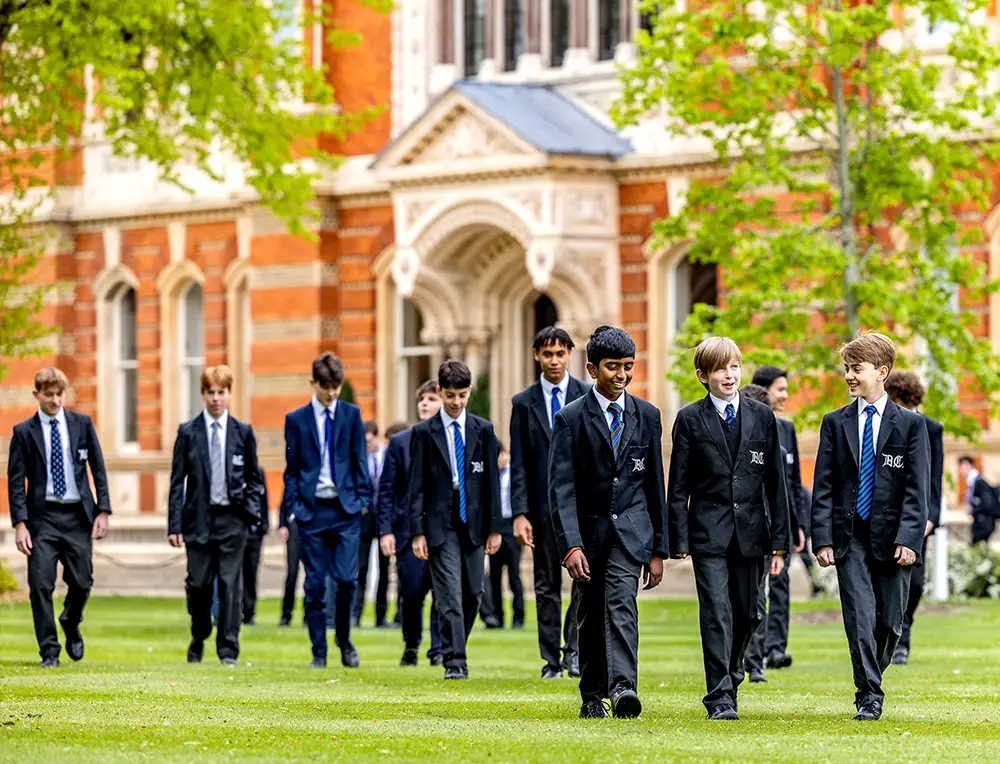
For September 2027 entry
Dulwich College is a selective boys’ school in south London. Around 90 external pupils join Year 7 alongside boys moving up from its Junior School. For 2027 entry, the assessment combines six online sections with a short handwritten description; promising candidates return for an interview.
At a glance
- School
- Independent · boys · day at 11+
- Year 7 intake
- Around 90 external placesAbout 150 boys including Junior School transfers
- Apply by
- 2 November 2026 · midday
- Assessment
- Online tests, writing & interview
- Termly fee
- £10,662 incl. VAT · 2026–27Year 7 lunches included
- Bursaries
- Up to full feesMeans-tested; most awards made at 11+
Admissions contacts & visiting
- 11+ admissions
- the.registrar@dulwich.org.uk
- Admissions telephone
- 020 8299 9263
- Main school
- 020 8693 3601
- School coaches
- 020 8299 9262
School address
Dulwich Common, London SE21 7LD- Getting there
- West Dulwich is a 5–10 minute walk; the school also lists Tulse Hill and North Dulwich at about 15 minutes. Check a real morning and after-club journey. The Foundation Schools’ Coach Service covers many south London routes and some routes from central and west London.
- Parking
- Vehicle entrance is from Dulwich Common (A205) only. The school has limited visitor parking; use the event instructions and allow time to reach the correct entrance.
The published 2027-entry open mornings and Lower School tours have finished. Contact admissions about any remaining opportunity to visit before applying.
Inspection report
- Inspectorate
- Independent Schools Inspectorate
- Inspection
- 18–20 March 2025
- Outcome
- All school standards met
Inspectors found a focused, purposeful atmosphere in the Senior School, thorough support for SEND and extensive co-curricular opportunities. Their next steps concerned infant-to-junior transition and ensuring appropriate challenge throughout teaching below the examination years.
Who can apply?
- Boys born between 1 September 2015 and 31 August 2016 for September 2027 entry.
- Year 7 is a day-school route. Boarding starts in Year 9; the College does not sponsor day pupils for Child Student or Student visas.
- Choose Year 7 or deferred Year 9 entry: applicants cannot apply for both. The published route-change deadline was 2 October 2026.
- The Year 7 page specifies no general catchment radius. Bursary applicants have a separate travel requirement: approximately 50 minutes from the College, with no support for relocating into that area.
- Tell the current headteacher that a reference will be requested. Selection combines the examination, interview and school reference.
Access arrangements and supporting documents
Upload professional evidence of need and a letter from the current school describing the normal way of working when registering. The Learning Support team reviews arrangements under JCQ guidance; examples include extra time, supervised breaks and a word processor.
Declare requirements in the SEN section of the application. Tell the registrars about changes no later than 10 days before the examination. For agreed extra time, the online clock is adjusted automatically.
Dates & deadlines
All dates and times are UK time.
- Admissions portal
Registration closes
Upload supporting documents and pay the registration fee, or arrange the Pupil Premium waiver.
Entrance examination
About three hours including breaks; online tests and creative writing.
Music scholarship auditions
For selected musicians who also receive an academic-interview invitation.
Sports scholarship assessments
Attend the allocated date; candidates must be invited for an academic interview.
Academic interviews
The school plans to invite around 180 boys.
Offers emailed
Letters are posted first class on 11 February.
Acceptance deadline
Follow the offer instructions and confirm the applicable deposit.
Bursary applicants receive a financial-assessment form at the beginning of November and must complete it by the end of November. Use the precise deadline supplied with that form.
How to apply
Register by midday on 2 November
Create or sign into the admissions portal. Have a passport, birth certificate, recent photograph and latest school report ready, with medical or educational evidence where applicable. UK examination registration costs £200.
Flag financial support and adjustments
Tick the bursary box if needed. Pupil Premium families should upload their school’s confirmation, stop before payment and call admissions so the team can complete the fee waiver.
Attend the 4 December assessment
Expect six online sections and a 20-minute creative-writing task, with breaks during the approximately three-hour visit. Read the allocated arrival instructions carefully.
Interview, offer and decision
Shortlisted boys attend between 20 and 27 January. Offers are emailed on 12 February; acceptance is due by midday on 3 March.
Places, interviews and competition
Dulwich publishes around 90 external Year 7 places and around 180 interview invitations. Junior School transfers bring the full year group to about 150. The interview figure is a shortlist, not an applicant total or a number of offers.
No current matched applicant-and-acceptance totals or numerical pass mark are published on the Year 7 page. Use practice to improve understanding and accuracy rather than treating a commercial target score as a Dulwich cutoff.
Exam format
Online assessment
4 December 2026
Six sections · mostly multiple choice
- Subjects
- Maths, English, verbal and non-verbal reasoning, puzzles and creative comprehension
- Time
- 105 minutes in total
Paper and pencils supplied; no dictionaries, calculators or mobile devices.
Try the official familiarisationCreative writing
Same examination visit
Handwritten; typing only where agreed
- Subjects
- Detailed description from a picture
- Time
- 5 minutes planning + 15 minutes writing
Check spelling, grammar and punctuation.
Download the current writing specimenInterview
20–27 January 2027
Friendly discussion for shortlisted boys
- Focus
- Academic strengths, interests and contribution to school life
Exam format
| Online section | Time | Can answers be revisited? |
|---|---|---|
| Mathematics | 20 minutes | No · adaptive |
| English | 30 minutes | Yes |
| Non-verbal reasoning | 10 minutes | No · adaptive |
| Verbal reasoning | 10 minutes | No · adaptive |
| Puzzles and problem solving | 15 minutes | Yes |
| Creative comprehension | 20 minutes | Yes |
Maths and English cover Key Stage 2. A few online answers require a typed word or number. Read instructions and confirm an answer before moving on in an adaptive section; in the other sections, use review time to check uncertain answers.
Practical details for the day
The whole assessment visit lasts about three hours including breaks. Each online section has its own on-screen clock. Pencil cases are not required because the school supplies working materials.
If an exceptional network outage prevents online testing, the school says it will use paper maths and English examinations. The school’s familiarisation remains the first preparation resource.
Dulwich papers
Start with the current online familiarisation and the school’s creative-writing specimen. The eleven library downloads below include ten standalone maths papers and booklet H, which contains English as well as maths.
Current online familiarisation
Explore each section before timing practiceExamples for all six online subjects; the live assessment includes adaptive sections.
Current creative-writing specimen
20 minutes · 5 planning + 15 writingA picture prompt with the school’s stated writing criteria.
All papers on Elevenfold
View the collectionDulwich · Maths Specimen Paper A
60 minutes · historical format
Undated written practice. Current Year 7 maths is a 20-minute online section.
Dulwich · Maths Specimen Paper B
60 minutes · historical format
Undated written practice. Current Year 7 maths is a 20-minute online section.
Dulwich · Maths Specimen Paper C
60 minutes · historical format
Undated written practice. Current Year 7 maths is a 20-minute online section.
Dulwich · Maths Specimen Paper D
60 minutes · historical format
Undated written practice. Current Year 7 maths is a 20-minute online section.
Dulwich · Maths Specimen Paper E
60 minutes · historical format
Undated written practice. Current Year 7 maths is a 20-minute online section.
Dulwich · Maths Specimen Paper F
60 minutes · historical format
Undated written practice. Current Year 7 maths is a 20-minute online section.
Dulwich · Maths Specimen Paper G
60 minutes · historical format
Undated written practice. Current Year 7 maths is a 20-minute online section.
Dulwich · Maths Specimen Paper H
English 45 min · maths 60 min
For 11+ and 12+; English on PDF pages 2–3, maths on pages 4–7. Repeats two individual questions found in I.
Dulwich · Maths Specimen Paper I
60 minutes · historical format
Undated written practice. Current Year 7 maths is a 20-minute online section.
Dulwich · Maths Specimen Paper J
60 minutes · historical format
Undated written practice. Current Year 7 maths is a 20-minute online section. In Q21, give the side length in cm; the answer line incorrectly prints cm².
Dulwich · Maths Specimen Paper K
60 minutes · historical format
Undated written practice. Current Year 7 maths is a 20-minute online section.
More English papers: passages and historical formats
These older papers are useful for close reading and writing. Their 70- or 80-minute formats are different from the current online English and 20-minute description. The 70-minute total includes 10 minutes reading; the 80-minute total also includes 10 minutes reading.
Tudor cottage · Ellen
80 minutes in the historical paperReading and creative writing; use as additional skill practice.
James at a new school
80 minutes in the historical paperReading and creative writing; use as additional skill practice.
Treasure Island · The Voyage
80 minutes in the historical paperReading and creative writing; use as additional skill practice.
An Unusual Meeting · Wart and Merlin
70 minutes in the historical paperReading and creative writing; use as additional skill practice.
Top Dog · Buck
70 minutes in the historical paperReading and creative writing; use as additional skill practice.
Graylake School 1717 · Nathan
70 minutes in the historical paperReading and creative writing; use as additional skill practice.
A Journey to Neverland
70 minutes in the historical paperReading and creative writing; use as additional skill practice.
The Specimen · Christopher
No time printed in this standalone copySame passage and questions as the English section of library booklet H.
The earlier Ellen version repeats the same questions with a shorter time allowance; the Merlin and Buck archives each contain duplicate scans. Choose a fresh passage for an unseen practice. No answer key is supplied with these links.
English: read closely and explain choices
The online English section lasts 30 minutes. The current taster includes a Darwin passage about tortoises, a word-meaning question, direct-speech punctuation and choosing the correct word in a sentence. Practise returning to the relevant line and checking the entire sentence before answering.
Locate the evidence
Ask your child to underline the exact words that support an answer. Distinguish what the text states from what a character guesses, claims or fears.
Explain a word in its sentence
Choose a replacement that preserves both meaning and grammar. A familiar word can have a different sense in another passage; test the replacement by reading the sentence aloud.
Explain an image, not just its name
In the historical Treasure Island sample, the crew’s movement is compared with rats. Identify the shared quality, then explain what it makes the reader imagine about the busy ship.
Proofread one thing at a time
Practise sentence boundaries, speech punctuation, tense and commonly confused words. Ask what part of the sentence requires the chosen word, rather than relying on how it sounds.
Use the older written papers for deeper reading
The archive offers seven different passages: Ellen facing an accusation of witchcraft; James trying to fit into a new school; Jim Hawkins and Long John Silver; the Wart meeting Merlin; Buck before he is stolen; Nathan waking at Graylake School; and the Darling children flying to Neverland. Library booklet H adds Christopher’s encounter with an underground machine.
These tasks reward precise retrieval, supported inference, contextual vocabulary and discussion of individual words. In the Buck paper, track how confidence becomes fear; in the Ellen paper, distinguish her outward composure from her private anxiety. In the Merlin paper, explain what a comic detail suggests about character.
Give each answer the number of distinct points requested. Quoting the passage is useful when required, but an explanation should say how that evidence supports the answer. Check the later pages: several older papers place substantial questions after their creative-writing task.
Vocabulary to learn and use
Start with five words. Explain each in its passage, then use it in a new sentence before revealing the meaning. Return a few days later and check that your child can still use it accurately.
Maths skills & practice
Secure Key Stage 2 calculation first, then practise using it inside an unfamiliar problem. The written specimens repeatedly combine fractions, diagrams, changing totals and a rule that must be applied carefully. Use the questions below as short teaching sets; the current online maths section lasts 20 minutes.
Calculation and decimal place value
Build reliable written methods, align decimal points and estimate before calculating. Practise negative results and brackets as well as the four basic operations.
Check the method: Can your child explain why the decimal point belongs there and check a division by multiplication?
Fractions, percentages and the whole
Switch fluently between equivalent forms. In a fraction-of-the-remainder question, label the new whole before the second calculation; for a percentage comparison, identify which person represents 100%.
Check the method: In C’s sock problem, which socks does the second fraction refer to? In F’s money problem, whose amount is the percentage based on?
Factors, primes and simultaneous conditions
List candidates systematically, then apply every condition. Combine prime factors, divisibility, remainders and upper/lower limits rather than guessing from one clue.
Check the method: Can your child explain why a rejected candidate fails, and why no other candidate has been missed?
Sequences and rules you have just been given
Check differences, multiplication and alternating changes. Build a table for a growing diagram; test a proposed rule on each supplied term before extending it or finding a threshold.
Check the method: Can your child explain the growth in the picture as well as the numerical pattern?
Money, proportion, time and geometry
Money and bounded combinations
Work in one unit, find what remains in the budget, and round a purchase count down to a whole number. For inverse shopping questions, list one item count and calculate the other.
Check the method: Does the final shopping basket reproduce both the total spending and the stated change?
Ratio, shared work and proportional reasoning
Distinguish sharing a total from comparing two amounts. For people-time-output questions, calculate the work completed by one person in one unit of time, keeping the assumed equal work rate explicit.
Check the method: If the number of workers doubles for the same job, does your child expect the time to halve before calculating?
Timetables, elapsed time and speed
Draw a time line across midnight or a time-zone change. In timetable questions include the walks at both ends, and work backwards when asked for the latest departure. Convert minutes to a fraction of an hour for speed.
Check the method: Can your child distinguish 3 hours 30 minutes from 3.30 hours and explain why the next train may be too late?
Area, perimeter and missing lengths
Label missing sides before calculating. Split compound shapes or subtract unwanted pieces. Rearranging identical pieces preserves area but can change the exposed boundary.
Check the method: Ask your child to trace the outside edge and explain why an internal join is excluded from perimeter. Are the final units length or square units?
Angles, coordinates and transformations
Use angle totals with a stated reason. Plot x before y, including negative coordinates. Reflect each vertex at equal perpendicular distance from the mirror; for rotation, keep the centre fixed.
Check the method: Can your child distinguish a half-turn from a reflection, and recover an endpoint when given a midpoint?
Data, counting and harder reasoning
Charts, averages and changing totals
Read scales and sector angles carefully. Recover a total from mean × count before adding or removing a value. A combined mean must account for the size of each group.
Check the method: Can your child say what the total becomes, and why averaging two group means directly may be wrong?
Probability, sets and complete counting
Count eligible outcomes against the whole set. For codes or number plates, state whether repeats and order matter. Keep overlaps in a Venn diagram and count each object only once.
Check the method: Can your child list a small version to check a counting rule, and distinguish an impossible outcome from an unlikely one?
Unfamiliar operations and linked equations
Rewrite a new symbol as an ordinary instruction. Substitute in the stated order, then reverse the steps to find an input. With linked totals, eliminate shared quantities or test one consistent set of values.
Check the method: Can your child explain the operation without using its symbol and substitute the answer back into every original statement?
Cubes, hidden blocks and fractional areas
Classify small cubes by position: corner, edge, face or interior. In shaded diagrams divide the whole into equal-area pieces before counting; in solid towers include hidden blocks.
Check the method: Ask your child to build a small example and explain why touching a face differs from touching an edge or corner. Where is the whole in the area fraction?
Logic, constraints and explaining why
Record all rules before experimenting. Use a small table or diagram to track a toggle game, calendar pattern or several clues; check a proposed solution against the full set of conditions.
Check the method: Can your child give a reason a pattern must continue, rather than only another example?
After an error, ask your child to explain the missed condition or method, then try a fresh question of the same kind a few days later. A repeated question from another booklet is a useful review, but it cannot measure unseen performance.
A description in twenty minutes
The current specimen asks for a detailed descriptive response to a picture. It rewards originality and imagination, an appropriate voice and style, imagery, and ambitious but accurate vocabulary, punctuation and sentence structures.
The specimen picture shows a canoe on still water, a wooded island, pale sky and mist. Choose how to move the reader’s attention through that scene: distant light, the island’s outline, then a close movement or sound. Let the atmosphere develop through details that belong together.
Five minutes · choose a viewpoint
Decide where the observer stands, the mood and three details worth developing. Plan a movement of attention: whole scene, close detail, final impression.
Fifteen minutes · write and check
Keep the response centred on the picture. Use precise nouns and verbs; develop a small number of details instead of listing everything visible. Reserve a short check within writing time for sentence endings, tense and spelling.
Parent check · ask what each choice achieves
Can your child point to a deliberate image, explain the atmosphere and identify one sentence improved in revision? An unusual word earns its place only if its meaning fits.
Stretch writing with the historical tasks
The Ellen paper asks for third person and past tense from the hidden girl’s position. The Buck paper asks for the dog’s point of view. Treasure Island asks for a storm description and then a captain’s log combining admiration with suspicion. These are useful exercises in voice, evidence and perspective.
Check a continuation against the passage before polishing it: does the character know only what he or she could know; does the setting fit; is the viewpoint consistent? When using the current picture prompt, keep the emphasis on a detailed description rather than rushing through a long adventure.
Reasoning, puzzles & creative comprehension
Creative comprehension asks your child to combine information from different sources. In the current taster, those sources include a map, a symbol code and a graph about the age of an object. The separate creative-writing task is the handwritten description.
Verbal reasoning · respect the wording
Practise making compound words, matching close meanings and deciding what must follow from supplied statements. A statement that sounds plausible is insufficient: trace the deduction back to the given facts.
Non-verbal reasoning · separate visual rules
Describe one change at a time: position, orientation, number or reflection. The older written papers B and C include rotated and reflected words, while G asks for successive transformations of a patterned tile. Use those to explain the difference, then try the official online examples.
Puzzles · record every rule
The taster includes missing-digit subtraction, paths linking solids to their number of vertices, and arranging portraits under adjacency conditions. Try a small organised list or table, then check that every rule still holds.
Creative comprehension · choose the relevant source
Locate the information needed before calculating or inferring. Read map keys, coordinates and graph axes; distinguish a source’s evidence from outside knowledge. Explain which source supports each step.
Screen practice · separate working from answering
Use draggable items to explore the puzzle, then select the separate answer option. Practise scrolling both the material and the question. In English, puzzles and creative comprehension, review earlier answers; adaptive sections require a decision before moving on.
A practical preparation plan
Begin with the current examples
Explore all six online subjects and the writing specimen together. Separate a misunderstanding of the screen controls from a gap in English or maths.
Choose two priorities each week
Use one short maths set and one close-reading passage. Record the reason for errors: calculation, vocabulary, overlooked condition or method. Teach that point and return to it with different questions.
Keep writing short and purposeful
Once a week, use the current five-minute plan and fifteen-minute writing limit. Improve one paragraph afterwards: sharper verbs, a clearer image or more controlled sentence endings.
Build independent checking
For revisitable online sections, practise using the remaining time to check uncertain answers. For adaptive maths and reasoning, read the final choice carefully before submitting.
Near the assessment
Keep one unfamiliar passage or paper section aside. Use it to check transfer of learning, then reduce new material and confirm the journey, arrival time and agreed access arrangements.
Aim for steady, short sessions that leave time for ordinary reading, sleep, sport and interests. Dulwich’s interview also gives your child space to talk about what he enjoys beyond preparation.
The interview
Dulwich describes a friendly conversation that lets a boy show his academic strengths, interests and the contribution he could make to College life. Around 180 boys are invited.
- Discuss a book, activity or school topic your child actually enjoys. Ask for a specific example and a reason.
- Practise explaining how he tackled a problem, including a mistake and what he changed.
- Let him speak in his own words. Follow-up questions should help him think aloud rather than recite a prepared answer.
- Revisit what interested him on a school visit or in the Lower School film, and connect it to something he would like to try.
Fees & acceptance costs
- Year 7 day fee
- £10,662 per term2026–27 · includes VAT and compulsory school-day lunches
- Three-term total
- £31,986Calculated from the current termly fee; future fees may change
- Registration
- £200 UK · £440 overseasBased on examination location; non-refundable
- Day-pupil deposit
- £2,500Published for 2026–27; returned on leaving less amounts due
The fee schedule is for 2026–27. Budget using it as a reference and confirm the 2027–28 fee and deposit in the offer. Check separately for uniform, transport, instrumental lessons and optional activities.
Payment and overseas-parent arrangements
Fees are normally paid by Direct Debit before the first day of term. Withdrawal requires a full term’s written notice or a term’s fees in lieu.
Where parents are outside the UK when accepting, or provide an overseas address, the school requires a term’s tuition fees in advance as well as the deposit. That advance payment is credited against the first term’s invoice.
Bursaries & fee assistance
Means-tested bursaries can cover all or part of fees; most are awarded at Year 7 entry. The College reports 200 bursary awards and 125 fully funded places across the school, rather than an annual Year 7 quota.
Request support when registering
Tick the bursary box. A separate financial form follows at the beginning of November and is due by the end of that month.
Prepare the financial evidence
Bursary Assessment Associates reviews income, assets and liabilities and conducts a home or online meeting. Awards arrive with the place offer.
Review the full commitment
Awards are reviewed annually. A deposit remains payable, with the published amount as low as £200 for a full bursary; confirm your individual award.
Eligibility, travel and what support covers
The school’s guide includes combined gross household income below £110,000; both parents working or seeking employment; one mortgaged home or rented accommodation; and savings and/or discretionary spending below £10,000. These are guidelines for an individual means assessment, with capital, property equity, other support and wider family circumstances also considered.
Families should live within approximately 50 minutes’ travel. The College says it cannot support bursaries for families relocating from outside that area.
Bursaries cover all or part of tuition and textbooks, with support for one educational and one sports trip each year. Full bursaries also include lunches, applicable Foundation coach travel, a uniform allowance, a trial of music lessons up to £250 a term and public-examination fees.
Pupil Premium: registration and free preparation
Pupil Premium families can have the registration fee waived. Upload current-school confirmation, complete the form up to payment and call admissions before submitting.
Eligible Year 5 and Year 6 pupils can also receive free Atom Home access through Dulwich’s partnership after their primary school verifies their status.
Academic, music & sports scholarships
At 11+, academic and music awards can be worth up to one third of tuition fees; sports awards are typically 10%. Combined scholarships cannot exceed one third, but a means-tested bursary can supplement them.
- Academic: all entrance candidates are considered automatically, using examination and interview performance.
- Music: indicate interest when registering. Grade 5 on the main instrument is a guide at 11+; the school ideally expects two instruments, including an orchestral instrument. The audition looks for aptitude and promise.
- Sport: submit the scholarship application and supporting references through registration. Candidates must also meet the academic requirements.
- Music auditions are on 9 January; sports assessments are on 18 or 19 January 2027, for selected candidates invited to the academic interview.
Academic results
2026 whole-cohort results · school summary, reviews ongoing
| Qualification | Published result |
|---|---|
| GCSE | 95% grades 7–9 · 84% grades 8–9 · 58% grade 9 |
| A level, excluding EPQ | 68.7% A*–A · 90.1% A*–B |
| A level, including EPQ | 69.9% A*–A · 90.6% A*–B |
The published summary covers 230 GCSE candidates and 236 A-level candidates. These are grade percentages, rather than the percentage of pupils achieving all top grades.
Life beyond the entrance test
The March 2025 inspection describes a broad curriculum, including classics and several modern languages, supported by numerous clubs and societies, many initiated and run by pupils. It also highlights pupils’ enthusiastic participation and the confidence developed through leadership.
On a visit, connect that breadth to your child’s week: which club would he actually join, how would he get home afterwards, and how are academic challenge and learning support organised in the Lower School?
Other entry points
Dulwich has separate Junior School, Year 9 and sixth-form admissions routes. A boy in Year 6 must choose between immediate Year 7 entry and deferred Year 9 entry; boarding is available from Year 9.
Other schools to compare
Coeducational day school in Dulwich; useful for comparing a mixed-school environment and its separate 11+ assessment.
Boys’ school in South Croydon; compare the full journey, co-curricular commitments and bursary arrangements.
Dates and fees relate to the published admissions cycle and fee year shown. Follow the school’s individual invitation for arrival, access arrangements and acceptance instructions.